Close Ended Questions Examples: Types & When to Use Them
Staff Writer • December 26, 2024 • Uncategorized, marketing, survey
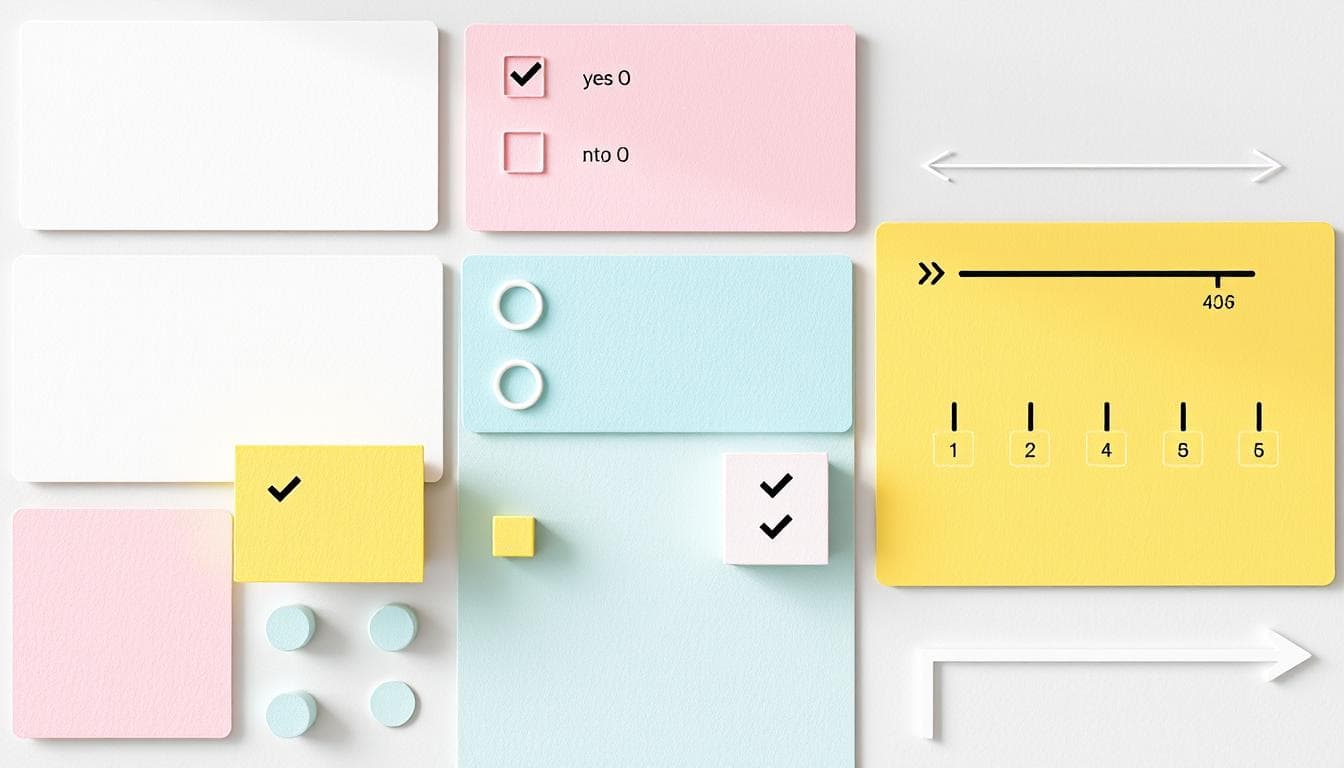
Close-ended questions are made to get simple, clear answers from people taking surveys. They often ask for "yes/no", "true/false", or multiple choice answers. These questions are great for getting numbers that can be easily sorted for reports.
They make surveys easy and quick to understand. For example, questions like "Was your support issue resolved?" or "How often have you visited our store in the past 12 months?" fit well here. Rating scale questions like "How satisfied were you with your ability to find what you were looking for?" also work well. 🎯✨
Key Takeaways
- Close-ended questions are designed to gather focused, quantitative data that can be easily analyzed.
- They offer a straightforward survey experience with pre-populated answer options.
- Examples include dichotomous, multiple choice, and rating scale questions.
- Close-ended questions are very efficient for big surveys with lots of people.
- They help get more answers and give clear, important insights.
Understanding Close-Ended Questions: Definition and Purpose
Close-ended questions are key in surveys and data collection. They have set answers, making analysis easier. This makes quick data collection and result quantification possible.
What Makes Questions Close-Ended
Close-ended questions limit answers to a set list, like "yes/no" or multiple-choice. This is different from open-ended questions, which let people answer freely.
Differences Between Open and Close-Ended Questions
Open-ended questions give deeper insights but are slower to analyze. Close-ended questions are better for quick analysis and specific data. They're great for big surveys and testing hypotheses.
Benefits of Using Close-Ended Questions
The main benefits of close-ended questions are:
- They make data analysis easier and quicker.
- They get more answers because they're simple.
- They help quickly see overall opinions and trends.
Using both close-ended and open-ended questions helps get a full picture of what people think and feel.
| Question Type | Description | Example |
|---|---|---|
| Dichotomous | Offers only two possible answers, such as "yes" or "no". | Did you find the product easy to use? |
| Multiple Choice | Provides a selection of answers for respondents to choose from. | What is your preferred method of payment? |
| Rating Scale | Quantifies sentiment or agreeableness using a scale (e.g., very dissatisfied to very satisfied). | On a scale of 1 to 10, how likely are you to recommend our service? |
| Rank Order | Asks participants to list preferences in numerical order. | Rank the following features in order of importance to you. |
Close-ended questions help businesses and researchers get important data. This leads to better decisions and ongoing improvement. 📊🔍
Close Ended Questions Examples: Essential Types for Surveys
Close-ended questions are key in surveys for getting clear data. They give people set choices, making it easier to understand their answers. Here are the main types of close-ended questions that are great for surveys.
- Dichotomous Questions: These have only two choices, like "Yes/No" or "True/False." They're simple and quick to answer.
- Multiple Choice Questions: People can pick one or more answers from a list. This shows what they like or think.
- Rating Scale Questions: These use numbers, like 1 to 5 or 1 to 10, to measure how satisfied or agreeable someone is.
- Likert Scale Questions: A special rating scale with 3, 5, or 7 points to see how much someone agrees or disagrees.
- Rank Order Questions: People rank a list of options by what they like most. This shows their top choices.
- Checklist-style Questions: Respondents can pick many options from a list. This gives a full view of what they prefer or have done.
Each type of close-ended question has its own use. They help get different kinds of data, from simple yes/no answers to detailed opinions. Using these question types helps gather clear data. This leads to better decisions and understanding of what people want.
https://www.youtube.com/watch?v=23z93Q7pf8A
| Question Type | Purpose | Example |
|---|---|---|
| Dichotomous | Gather binary responses | Do you currently use our product? |
| Multiple Choice | Understand preferences | Which feature do you use the most? |
| Rating Scale | Measure satisfaction or agreement | On a scale of 1 to 10, how likely are you to recommend our service? |
| Likert Scale | Assess degree of agreement | I am satisfied with the customer support provided by the company. |
| Rank Order | Understand priorities | Rank the following features in order of importance to you. |
| Checklist | Gather multiple selections | Which of the following features do you use regularly? |
Adding limited response questions, polar questions, and rating scale questions to your surveys is smart. It helps get data that leads to better choices, deeper customer insights, and business success.
When to Use Close-Ended Questions in Research
Close-ended questions are great for research, mainly for collecting numbers. They offer a few choices, making it easy to analyze and compare the data. 📊
Quantitative Data Collection
For data that can be counted and analyzed, close-ended questions are perfect. They keep answers focused, helping to spot trends and confirm theories. This makes it simpler to draw conclusions.
Large-Scale Surveys
In big surveys, speed and reach are key. Close-ended questions are ideal here. They let many people answer quickly, boosting the survey's success rate.
Specific Parameter Research
For detailed studies, like understanding customer likes or dislikes, close-ended questions are best. They target the exact data needed, giving insights that guide smart choices.
Using close-ended questions helps researchers get the numbers they need. This way, they can make informed decisions and understand their audience better. 🔍
Conclusion
Close-ended questions are key in survey design and research. They offer many benefits for businesses and researchers. These questions help gather data quickly and make analysis easier. They are perfect for collecting specific data and for big surveys.
But, it's important to mix close-ended questions with open-ended ones. This way, you get a full picture of what people think and feel. It helps you understand their opinions and reasons better.
When making surveys, think about what you want to learn, who you're asking, and what data you need. Use different close-ended questions like scale-based, agreement, and evaluation questions to get useful insights. Always think about how your questions will affect your respondents.
In short, close-ended questions are great for improving your surveys and data collection. By using them wisely and adding open-ended questions, you can really understand your audience. This knowledge helps you make better decisions and grow your business.
FAQ
What are close-ended questions?
Close-ended questions are simple and direct. They ask for yes/no answers or multiple choices. This makes it easy to collect data that can be broken down for reports.
What are the benefits of using close-ended questions?
Close-ended questions have several advantages. They make it easy to analyze data and understand opinions quickly. They also help in getting more responses because they are straightforward. This is great for big surveys and research that needs specific details.
What are the different types of close-ended questions?
There are several types of close-ended questions. These include yes/no, true/false, and multiple choice. There are also rating scales, Likert scales, and checklist questions. Each type helps in different ways to gather information.
When should you use close-ended questions in research?
Use close-ended questions when you need clear, measurable data. They are good for statistical analysis and checking hypotheses. They're also useful for quick surveys and comparing different groups. This is perfect for measuring things like customer satisfaction or what people like.